
Pacific halibut (Hippoglossus stenolepis) are the most prized bottomfish on the Washington coast. They're large, powerful, and outstanding table fare — but the season is short and tightly managed, so showing up with the wrong setup means a wasted trip. This guide covers the complete halibut rig from mainline to hook, with everything you need to be ready on opening day.
The Halibut Spreader Bar Rig
The spreader bar rig is the standard halibut setup used throughout Washington waters. It presents your bait at a consistent height off the bottom while keeping the sinker separate from the hook — so when a halibut picks up the bait and moves off, it doesn't feel the weight of the lead immediately.
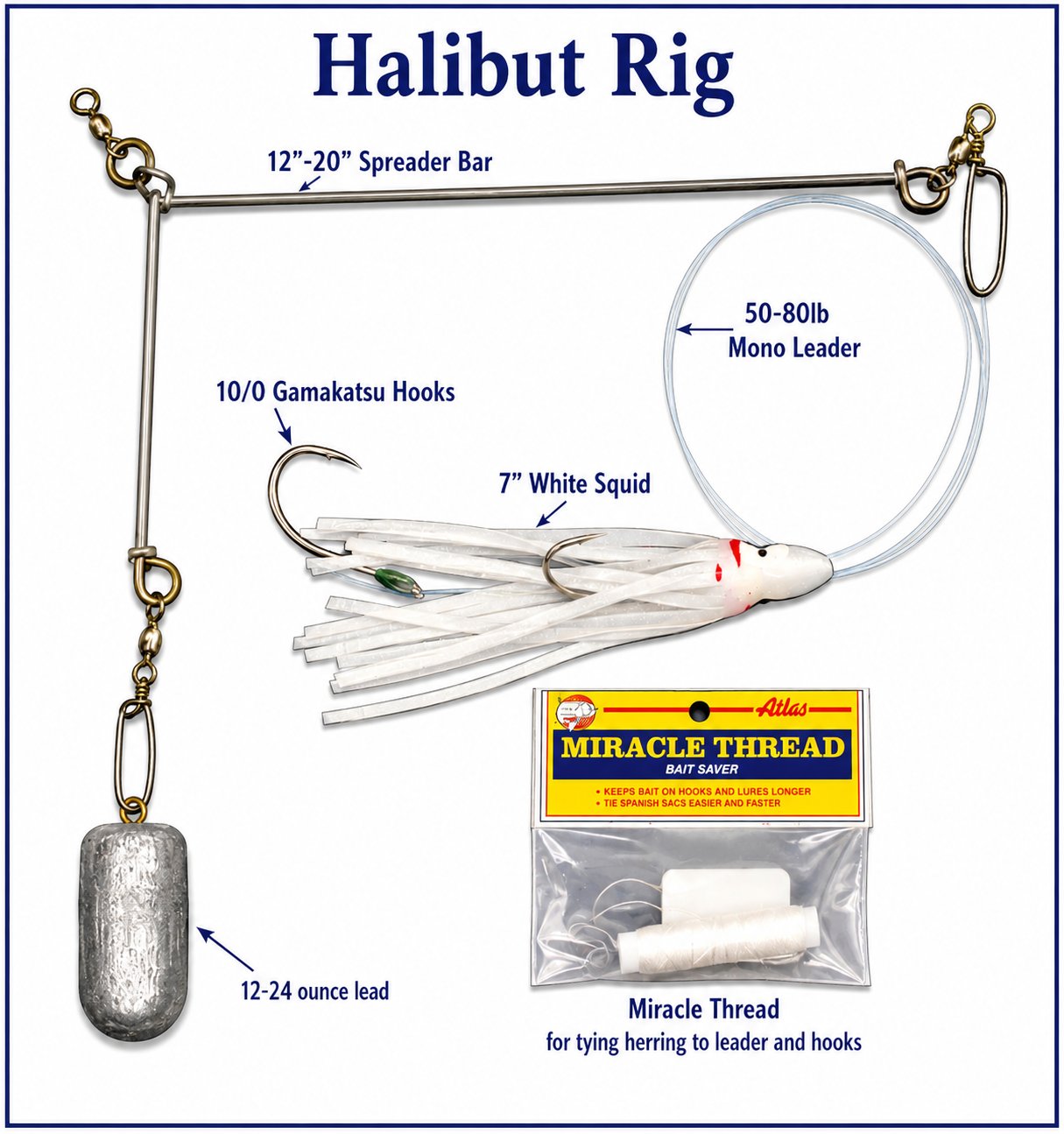
Components
Spreader Bar: A 12–20 inch stainless steel or brass spreader bar with a swivel on each end and a center drop for the sinker. The bar keeps the weight and the bait leader running parallel rather than tangled together. Shorter bars (12") work in moderate current; longer bars (20") give more separation in strong tidal flow.
Sinker: 12–24 oz torpedo or cannonball sinker on a dropper from the center of the spreader bar. Use enough weight to maintain bottom contact with your line at a reasonable angle. In the strong current off Neah Bay or through the Strait, 20–24 oz is common. Use a quick-change snap so you can swap weights without re-rigging.
Leader: 50–80 lb monofilament in a loop (18–24 inches of doubled line) connecting from the right-side swivel on the spreader bar to your hook. The looped mono allows the bait to move naturally while maintaining strength. Many anglers pre-rig these loops at home.
Hooks: 9/0–10/0 circle hooks or J-hooks (Gamakatsu is a popular brand among Washington halibut anglers). Circle hooks are strongly recommended — they seat themselves in the corner of the mouth when the fish moves off with the bait, dramatically reducing gut-hooking and improving landing rates. Do not snap-set a circle hook — simply reel down until the line comes tight and lift the rod steadily.
Miracle Thread (bait thread): A fine elastic thread used to secure soft bait like herring or squid to the hook and leader. Wrapping bait with miracle thread keeps it from spinning off on the drop and dramatically extends its life on the hook. Essential when using whole herring or strips.
Rigging the Spreader Bar
- Attach your mainline to the left-side swivel on the spreader bar
- Clip the sinker dropper to the center snap
- Attach the pre-looped leader to the right-side swivel
- Thread your hook through the bait and secure with miracle thread if using soft bait
- Lower to the bottom — reel up 2–3 cranks to keep bait just off the sand
Bait Options
7" White Squid: The most commonly used halibut lure in Washington. A large white squid skirt over a circle hook presents well, holds up to current, and produces consistently. Fish it alone or tipped with a strip of herring belly.
Whole Herring: Thread the hook through the lower lip or nose. Secure with miracle thread wrapped around the body. A 5–7 inch herring rolled in Pro-Cure brine adds scent and firms the flesh.
Salmon Belly Strips: 6–10 inch tapered strips of salmon belly are excellent halibut bait — oily, visible, and durable. Thread the hook through the narrow end and wrap with miracle thread.
Octopus: A whole small octopus or large arm section is highly effective, particularly in Northwest waters. The arms move naturally in current and release a strong scent trail.
Rod, Reel, and Mainline
Rod: 6–7 ft heavy conventional rod rated for 50–100 lb line. You need backbone to lift a large halibut from depth and enough power for a firm hook set.
Reel: Large-capacity conventional reel (Penn Senator, Shimano Tekota 600, or similar) with a smooth, powerful drag. Halibut fishing at 150–300 feet requires enough line capacity for the depth plus backing.
Mainline: 65–80 lb braided line. Braid's zero-stretch gives you excellent bottom feel and hook penetration from depth. Use a 5–6 foot shock leader of 80 lb monofilament between the braid and the spreader bar to absorb the initial strike.
Hook Set and Fighting Halibut
With circle hooks — reel down steadily when you feel a take, then lift the rod smoothly. The circle hook seats itself. No snap-set needed.
With J-hooks — when you feel the fish take and move, drop the rod tip briefly (bow to the fish), then drive the hook home with a strong upward sweep.
Once hooked, halibut will make powerful initial runs, then sulk near the bottom. Keep steady pressure and work the fish up in stages — don't try to winch a large halibut straight to the surface. Take your time.
Regulations
Halibut seasons are set annually by the International Pacific Halibut Commission and WDFW. The recreational season is typically short — often limited to specific days or weekends — and a halibut license endorsement is required in addition to your base fishing license. Check WDFW's halibut page every spring for season announcement dates.
Gear We Recommend
| Gear | Link |
|---|---|
| Halibut Spreader Bar Rig | View on Amazon |
| Gamakatsu Circle Hooks 9/0-10/0 | View on Amazon |
| White Squid Hoochie 7" | View on Amazon |
| Miracle Thread Bait Saver | View on Amazon |
| Heavy Torpedo Sinkers 12-24 oz | View on Amazon |
| Penn Conventional Reel | View on Amazon |
| 80 lb Monofilament Leader | View on Amazon |
As an Amazon Associate I earn from qualifying purchases.
Current halibut season dates, area rules, and license requirements are at WDFW's fishing regulations page. Season dates change annually — always verify before your trip.