Walking into a tackle shop before your first Puget Sound salmon trip can feel overwhelming. Walls of flashers, bins of hoochies, racks of plugs, and a dozen styles of hooks — all claiming to be exactly what you need. The reality is that Puget Sound salmon trolling uses a fairly simple system once you understand the logic behind it. This guide breaks down proven rig setups for chinook, coho, and pink salmon so you can walk out of the shop with confidence.
The Basic Trolling System
Every Puget Sound salmon trolling rig shares the same fundamental structure, working from the downrigger weight up:
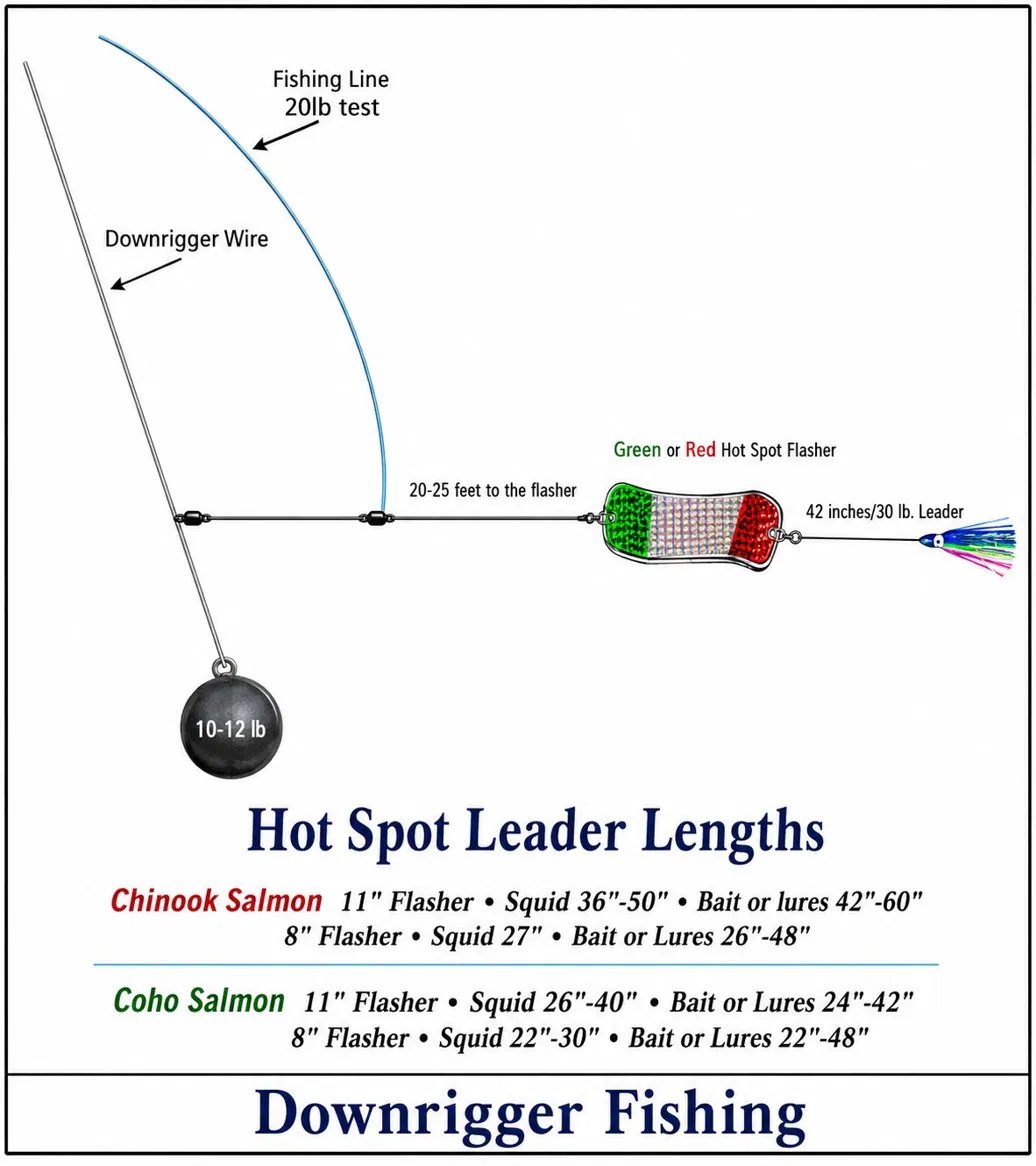
Downrigger weight → downrigger cable → release clip → mainline → swivel → leader → flasher → leader → lure or bait
The flasher and its leaders are the heart of the system. Everything else — depth, speed, color — is adjusted around this core setup.
Mainline and Leader Materials
Mainline: 20-30 lb monofilament or 30-50 lb braid. Many veteran Puget Sound anglers prefer monofilament for its stretch, which cushions the initial strike and reduces pulled hooks. Braid has better sensitivity and smaller diameter but is less forgiving on the hook set.
Leaders: 20-30 lb fluorocarbon throughout. Fluorocarbon is nearly invisible underwater and more abrasion-resistant than monofilament. Use it for both the leader between the mainline and flasher, and the shorter leader between the flasher and lure.
Chinook (King) Salmon Rig
Chinook are the deepest-holding and most line-shy of the Pacific salmon. Your rig needs to get down to 80-150 feet and present a natural, enticing action.
The Standard Chinook Setup
Flasher leader (above flasher): 36-48 inches of 30 lb fluorocarbon from your mainline swivel to the top of the flasher. Use a ball-bearing swivel at each end of this leader to eliminate line twist.
Flasher: 11-inch chrome, green, or "army truck" (green/yellow) flasher for chinook. Larger flashers create more pressure wave and vibration — important for attracting fish from a distance in the deeper, darker water where chinook hold.
Lure leader (below flasher): 18-22 inches of 25 lb fluorocarbon from the bottom of the flasher to your lure. Shorter leaders create more action; longer leaders give a more natural swing. For chinook, 18-22 inches is the standard — long enough for natural movement, short enough to maintain flasher influence.
Lure options: - Hoochie: A 4-5 inch green, chartreuse, or glow hoochie on a two-hook mooching rig. Thread the top hook through the nose of the hoochie and allow the trailing hook to hang at the tail. Use size 3/0-4/0 octopus hooks. - Cut plug herring: A 4-5 inch herring with the head cut at a 45-degree angle to create a spinning action. Rig on a two-hook mooching setup and adjust the angle of the cut until the bait rolls in a tight, consistent spiral. A bait brine solution (salt, Pro-Cure, or similar) firms the herring and extends its life on the hook. - Whole plug-cut herring: The same as cut plug but the entire body is used. Creates a slower, wider roll — preferred by many anglers targeting large chinook.
Trolling depth: 80-150 feet, set by your downrigger. Mark the productive depth on your sonar and set the downrigger ball to that depth. Check sonar frequently and adjust as fish move.
Trolling speed: 1.8-2.2 mph for chinook setups. Check your flasher action by briefly running the boat faster until you see the rod tip begin to pulse steadily — that's the flasher rotating correctly. Then slow back to target speed and verify the pulse continues.
Winter Blackmouth Chinook Adjustment
For winter blackmouth (immature chinook), the same basic setup applies with a few tweaks: - Smaller flashers (8-inch) in subdued colors work well in winter - Scale down to 3-4 inch hoochies in natural colors — white, pearl, or light green - Depths of 60-120 feet are most productive - Slower trolling speeds (1.6-2.0 mph) suit the colder, less aggressive fish
Coho (Silver) Salmon Rig
Coho are shallower, faster, and more aggressive than chinook. Your rig reflects this — brighter, faster, and closer to the surface.
The Standard Coho Setup
Flasher leader: 24-36 inches of 25 lb fluorocarbon above the flasher. Shorter than the chinook setup because coho are more reactive and don't require as much distance between the weight and the presentation.
Flasher: 11-inch or smaller (8-inch) flasher in chrome, pink, or white. For coho, bright and flashy is better. UV-finish flashers produce well in overcast or low-light conditions.
Lure leader: 18-24 inches of 20 lb fluorocarbon. Same range as chinook, but you can go longer (up to 28 inches) for a more natural swing when coho are wary.
Lure options: - Small hoochie: 3-4 inch hoochie in chartreuse, pink, white, or glow on a single or double hook. Coho hoochies are typically smaller and brighter than chinook setups. - Spoon: A trolling spoon like the Coho Killer, Coyote, or Silver Horde in chrome or blue/chrome, fished on a longer leader (24-30 inches) without a flasher for a subtler presentation. Effective when coho are heavily pressured. - Small plug: A 3.5-4 inch plug in chrome or pearl, run without a flasher on a 6-8 foot leader directly off the downrigger for a natural swimming action.
Trolling depth: 15-50 feet. Coho are surface-oriented and frequently visible on sonar at 20-40 feet. Start at 25 feet and adjust based on your screen.
Trolling speed: 2.5-3.5 mph — significantly faster than chinook. A faster presentation triggers the aggressive, reaction-strike tendency that makes coho so exciting to catch.
Pink Salmon Rig
Pink salmon (humpies) return to Puget Sound on odd-numbered years in massive numbers. They're smaller (3-6 lbs) but aggressive and school heavily, making them an outstanding light-tackle fishery.
The Standard Pink Setup
Pink salmon respond to simple, bright presentations. Elaborate rigs aren't necessary.
Option 1 — Casting and retrieving: A 1/2-1 oz pink or chartreuse buzz bomb, candlefish jig, or metal jig cast into visible surface schools and retrieved quickly with an erratic, twitching action. This is the most exciting way to fish pinks when they're surface active.
Option 2 — Trolling: A small pink or hot pink hoochie (2-3 inch) behind a small (8-inch) pink or chrome flasher, trolled at 2.5-3 mph in the 15-30 foot range. The setup mirrors a coho rig but scaled down in size and exaggerated in pink color.
Option 3 — Float and jig: A 3/8-1/2 oz pink or chartreuse tube jig or Buzz Bomb suspended under a float at 15-25 feet. Effective when pinks are holding in a specific depth band and trolling is impractical near shore or in confined areas.
Cut Plug Herring: The Classic Chinook Bait
Cut plug herring deserves special mention because it's so effective for large chinook and requires the most preparation to rig correctly.
Selecting the herring: Use fresh or properly thawed herring in the 4-5 inch range. Larger herring are sometimes preferred for trophy chinook. Brine the herring in a simple salt solution or commercial bait brine for at least 30 minutes before fishing — this firms the flesh, intensifies the color, and significantly extends durability on the hook.
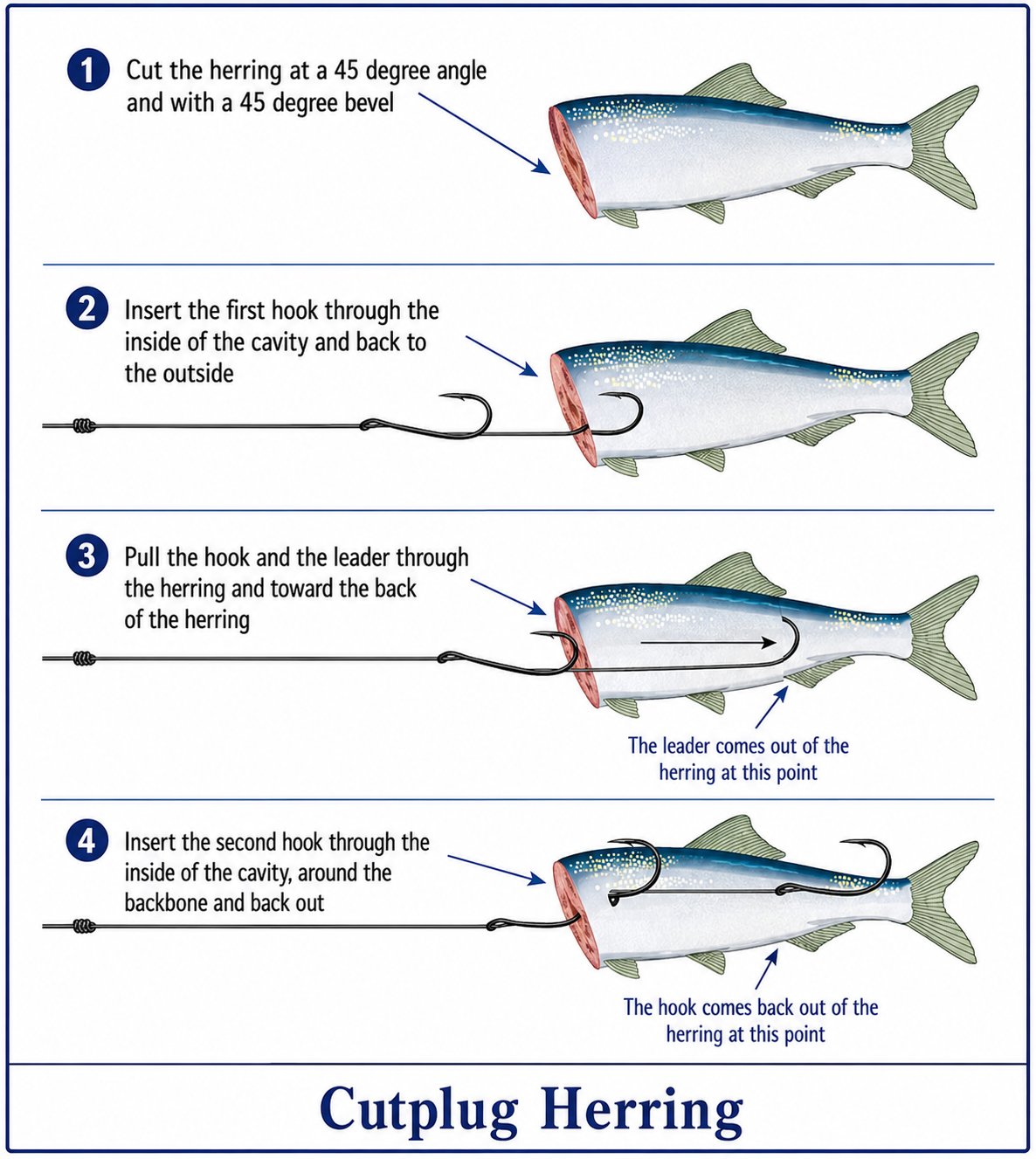
Making the cut: Cut the head off at a 45-degree angle, angling the cut so that when the bait is in the water, it creates a rotating action. The exact angle determines how tight or wide the roll — practice in a bucket of water before heading out.
Rigging the cut plug: 1. Thread the top hook of your mooching rig through the top of the bait near the cut, exiting out the back 2. Let the trailing hook hang freely alongside or just behind the tail 3. Check the roll in the water — a tight, even spiral is what you want 4. If the roll is too wide, make the cut angle slightly steeper; if too tight, shallower
Leader for cut plug: Use a longer lure leader — 22-26 inches — to allow the herring to roll freely without being stifled by flasher proximity.
Putting It Together: Quick Reference
| Species | Flasher | Lure Leader | Lure | Depth | Speed |
|---|---|---|---|---|---|
| Chinook | 11" chrome/green | 18-22" | Hoochie/cut herring | 80-150 ft | 1.8-2.2 mph |
| Blackmouth | 8" subdued | 18-22" | Small hoochie | 60-120 ft | 1.6-2.0 mph |
| Coho | 8-11" bright | 18-28" | Small hoochie/spoon | 15-50 ft | 2.5-3.5 mph |
| Pink | 8" pink/chrome | 18-24" | Small pink hoochie | 15-30 ft | 2.5-3.0 mph |
Common Rigging Mistakes
Leader too short: A lure leader under 14 inches doesn't give the lure enough freedom to swim naturally and reduces strike rates significantly.
Wrong trolling speed for the flasher size: Each flasher has a minimum speed needed to rotate. If you're not getting the steady rod-tip pulse that indicates proper rotation, speed up until it starts, then note that speed for future reference.
Hooks too small: Chinook have large, bony mouths. Use 3/0-5/0 octopus hooks for chinook — undersized hooks straighten out or pull free on large fish. Coho can be fished with 2/0-3/0.
Not checking bait: If you're using cut herring or whole bait, check it every 30-45 minutes. Jellyfish, debris, and the action of trolling degrade bait quickly. Fresh, properly rolling bait dramatically outperforms old, mushy bait.
Gear We Recommend
Here are the products referenced in this guide, available on Amazon:
| Gear | Link |
|---|---|
| Hot Spot Flasher 11" Chrome | View on Amazon |
| Hoochie Squid Skirts | View on Amazon |
| Cannon Downrigger | View on Amazon |
| Scotty Downrigger | View on Amazon |
| Deep Six Diver (downrigger alternative) | View on Amazon |
| Ball-Bearing Swivels | View on Amazon |
| Fluorocarbon Leader Line | View on Amazon |
| Pro-Cure Bait Brine | View on Amazon |
As an Amazon Associate I earn from qualifying purchases.
Always verify current season dates, species-specific rules, and retention regulations at WDFW's fishing regulations page before every salmon trip.